
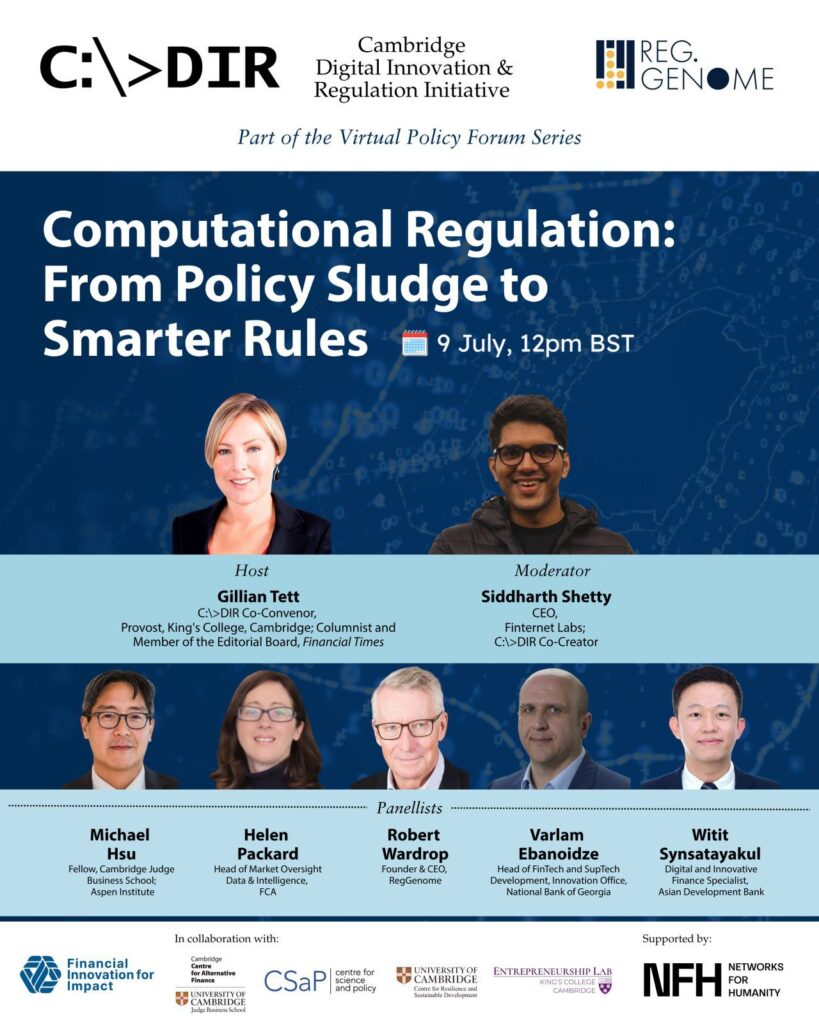
Watch on demand
AI can now analyse regulatory text at a scale and speed that were previously impractical. So why do overlapping, inconsistent and outdated requirements continue to accumulate?
Led by researchers, regulators and policymakers working at the intersection of regulation, policy and AI, this discussion gets to the heart of why regulatory complexity keeps growing and what it would actually take to address it.
The central argument
The constraint is not AI capability alone
The forum identified a more fundamental challenge: regulatory requirements are rarely structured, classified and connected in ways that allow them to be examined consistently across instruments, institutions and jurisdictions.
The objective is not simply to reduce the volume of regulation. It is to identify complexity that no longer serves a clear legal, prudential, conduct or public-policy purpose, while preserving necessary safeguards and jurisdiction-specific choices.
Regulatory requirements lack consistent digital structure
AI tools can analyse regulatory text, but requirements are rarely published with consistent identifiers, classifications and relationships across instruments and jurisdictions. Analysis must therefore reconstruct the meaning, provenance and legal context of each provision.
General-purpose AI is not enough
Financial regulation demands more than fluent text generation. Analysis supporting policy or supervisory work needs reliable source attribution, structured regulatory concepts, reproducible methods and expert validation.
Sludge is a policy and supervisory problem, not only a compliance problem
Fragmented requirements can obscure material risks, complicate supervisory judgement and impede coordination across authorities and jurisdictions. Their effects may be particularly acute for smaller institutions and authorities with limited specialist capacity.
Human judgement is non-negotiable
Technology can identify similarity, inconsistency and potential duplication at scale. But determining whether these reflect genuine sludge, different legal mandates, intentional proportionality, local market conditions or unresolved policy trade-offs remains a matter for accountable human decision-makers.
“The binding constraint today is not AI capability. The challenge is that rules have no stable digital identity, and if you don’t start with something reliable and consistent at origin, you are just compounding error as you move through.”
Bob Wardrop, Chairman & CEO, RegGenome
What the scale of the problem looks like
9,445
Reserve Bank of India circulars consolidated into 244 master directions, a process involving almost 40 staff over a full year
£100 million
Estimated consumer savings attributed by the FCA to streamlining its rules, achieved without AI
36%
Of mandated municipal reports were cut or consolidated following an AI-supported review
A framework for action
Embedding sludge review into the policy cycle
One of the forum’s clearest conclusions was that sludge review should not be treated as a one-off exercise. The ADB policy brief proposes embedding structured review into routine policy and supervisory workflows, so that unnecessary complexity can be identified, assessed and addressed before it accumulates again.
Detect
Identify potential overlaps, inconsistencies, obsolete provisions and fragmented requirements across international standards, legislation, regulation, guidance, reporting obligations and supervisory expectations.
Validate
Confirm the findings against legal hierarchy, institutional mandates, policy intent, proportionality and jurisdiction-specific context.
Decide
Determine which requirements should be retained, clarified, harmonised, consolidated, amended or removed, and which authority has the mandate to act.
Implement
Make approved changes through the relevant legal, regulatory or supervisory process, with a clear record linking each decision to its supporting evidence.
Monitor
Maintain a traceable view of the findings, decisions and outstanding issues, and assess whether subsequent policy changes create new overlaps or inconsistencies.
Go deeper
Explore the evidence and practical approaches
The forum connected policy research, regulatory experience and practical approaches to analysing complex frameworks. Explore the ADB policy brief, read Gillian Tett’s reflections, or learn how structured regulatory data can support policy review.
Read the ADB policy brief
Published by the Asian Development Bank, this brief explains how AI-enabled analysis and structured regulatory data can help authorities identify policy sludge, prioritise review and embed it into routine policy and supervisory workflows.
Read Gillian Tett in the Financial Times
Gillian Tett, who moderated the forum, examines the potential for AI to support regulatory simplification, the scale of existing review burdens and the importance of specialised tools and human oversight.
Speak to RegGenome
RegGenome helps policymakers and regulatory authorities analyse and compare regulatory frameworks by transforming regulatory information into structured, machine-consumable data, while keeping expert judgement and decision-making at the centre. Speak with us about applying a Regulatory Sludge Assessment to your framework.